

How To Increase R Value Of Windows
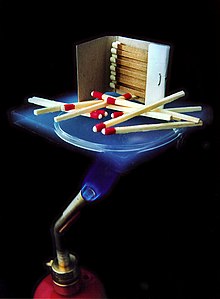
Aerogel is an extremely skilful thermal insulator, which at a pressure of one-10th of an atmosphere has an R-value of R-forty/chiliad,[ane] compared to R-3.5/m for a fiberglass coating.[2]
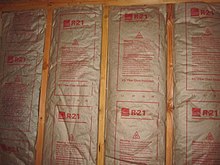
In the context of construction,[4] the R-value is a measure out of how well a two-dimensional barrier, such equally a layer of insulation, a window or a complete wall or ceiling, resists the conductive[5] period of heat. R-value is the temperature deviation per unit of heat flux needed to sustain one unit of heat flux between the warmer surface and colder surface of a barrier under steady-state conditions.
The R-value is the building industry term[iv] for thermal resistance "per unit area."[6] It is sometimes denoted RSI-value if the SI units are used.[7] An R-value can exist given for a textile (e.g. for polyethylene foam), or for an associates of materials (due east.chiliad. a wall or a window). In the case of materials, it is often expressed in terms of R-value per metre. R-values are additive for layers of materials, and the higher the R-value the better the functioning.
The U-cistron or U-value is the overall oestrus transfer coefficient and tin be found by taking the inverse of the R-value. It is a property that describes how well building elements conduct estrus per unit area beyond a temperature slope. [eight] The elements are commonly assemblies of many layers of materials, such as those that make upwards the building envelope. It is expressed in watts per square metre kelvin: W/(10002⋅K). The higher the U-value, the lower the ability of the building envelope to resist heat transfer. A low U-value, or conversely a high R-Value usually indicates high levels of insulation. They are useful as it is a way of predicting the composite behaviour of an unabridged building element rather than relying on the properties of individual materials.
Insulating camping ground products such equally sleeping mats and cream mattresses are often given a rating such every bit R-seven or R24, which may be called "the R Value" but is not the same. Information technology is intended every bit a unproblematic, non-technical rating which consumers tin can understand. Higher numbers are amend insulating.
R-value definition [edit]
This relates to the technical/constructional value.

where:
The R-value per unit of a bulwark'south exposed surface expanse measures the accented thermal resistance of the barrier.[ix]

where:
Absolute thermal resistance, , quantifies the temperature deviation per unit of heat period rate needed to sustain ane unit of heat period rate. Confusion sometimes arises because some publications use the term thermal resistance for the temperature divergence per unit of heat flux, but other publications use the term thermal resistance for the temperature departure per unit of heat flow rate. Further confusion arises considering some publications utilise the graphic symbol R to denote the temperature divergence per unit of measurement of oestrus flux, but other publications utilise the character R to denote the temperature difference per unit of heat period rate. This article uses the term absolute thermal resistance for the temperature difference per unit of heat flow rate and uses the term R-value for the temperature divergence per unit of heat flux.

In any event, the greater the R-value, the greater the resistance, and then the ameliorate the thermal insulating properties of the barrier. R-values are used in describing the effectiveness of insulating textile and in analysis of heat flow across assemblies (such as walls, roofs, and windows) nether steady-state conditions.[9] Heat flow through a barrier is driven by temperature deviation between two sides of the bulwark, and the R-value quantifies how effectively the object resists this drive:[10] [eleven] The temperature difference divided by the R-value and and then multiplied past the exposed surface area of the bulwark gives the total rate of heat period through the barrier, as measured in watts or in BTUs per hour.

where:
As long as the materials involved are dumbo solids in direct mutual contact,[12] R-values are additive; for case, the full R-value of a bulwark composed of several layers of material is the sum of the R-values of the individual layers.[9] [13]
For example, in winter it might be 2 °C outside and 20 °C inside, making a temperature difference of xviii °C or 18 K. If the material has an R-value of 4, information technology will lose 0.25 W/(°C⋅one thousandtwo). With an expanse of 100 m2, the oestrus energy being lost is 0.25 W/(K⋅thou2) × eighteen °C × 100 m2 = 450 West. In that location volition be other losses through the floor, windows, ventilation slots, etc. But for that material solitary, 450 Westward is going out, and can be replaced with a 450 W heater inside, to maintain the inside temperature.
RSI value [edit]
Note that the R-value is the building industry term[iv] for what is in other contexts chosen "thermal resistance" "for a unit expanse."[vi] Information technology is sometimes denoted RSI-value if the SI (metric) units are used.[7] [14] An R-value can be given for a material (due east.g. for polyethylene foam), or for an assembly of materials (east.g. a wall or a window). In the case of materials, it is oftentimes expressed in terms of R-value per unit length (eastward.m. per inch of thickness). The latter can be misleading in the case of low-density building thermal insulations, for which R-values are non additive: their R-value per inch is not constant as the cloth gets thicker, but rather usually decreases.[12]
The units of an R-value (run into below) are usually not explicitly stated, and and so it is important to determine from context which units are being used: an R-value expressed in I-P (inch-pound) units[15] is nigh five.68 times larger than when expressed in SI units,[16] so that, for example, a window that is R-2 in I-P units has an RSI of 0.35 (since ii/5.68 = 0.35). For R-values there is no difference between U.s. customary units and royal units. As far every bit how R-values are reported, all of the following mean the aforementioned thing: "this is an R-2 window";[17] "this is an R2 window";[xviii] [7] "this window has an R-value of 2";[17] "this is a window with R = 2"[19] (and similarly with RSI-values, which also include the possibility "this window provides RSI 0.35 of resistance to heat menstruum"[20] [7]).
Apparent R-value [edit]
The more than a cloth is intrinsically able to acquit heat, equally given by its thermal electrical conductivity, the lower its R-value. On the other paw, the thicker the material, the higher its R-value. Sometimes oestrus transfer processes other than conduction (namely, convection and radiation) significantly contribute to oestrus transfer within the material. In such cases, it is useful to introduce an "apparent thermal conductivity", which captures the effects of all 3 kinds of processes, and to define the R-value more more often than not equally the thickness of a sample divided by its apparent thermal conductivity. Some equations relating this generalized R-value, besides known every bit the credible R-value, to other quantities are:

where:
An apparent R-value quantifies the physical quantity called thermal insulance.
All the same, this generalization comes at a price because R-values that include non-conductive processes may no longer exist additive and may accept significant temperature dependence. In particular, for a loose or porous textile, the R-value per inch generally depends on the thickness, well-nigh e'er then that information technology decreases with increasing thickness[12] (polyisocyanurate ("polyiso") existence an exception; its R-value/inch increases with thickness[21]). For similar reasons, the R-value per inch also depends on the temperature of the cloth, commonly increasing with decreasing temperature (polyiso over again being an exception); a nominally R-13 fiberglass batt may be R-14 at −12 °C (10 °F) and R-12 at 43 °C (109 °F).[22] Nevertheless, in construction information technology is common to care for R-values as contained of temperature.[23] Note that an R-value may not account for radiative or convective processes at the material's surface, which may be an of import factor for some applications.[ citation needed ]
The R-value is the reciprocal of the thermal transmittance (U-gene) of a textile or assembly. The U.South. construction industry prefers to use R-values, nevertheless, considering they are additive and considering bigger values mean better insulation, neither of which is true for U-factors.[4]
U-cistron/U-value [edit]
The U-factor or U-value is the overall oestrus transfer coefficient that describes how well a building element conducts heat or the rate of transfer of estrus (in watts) through one square metre of a construction divided by the difference in temperature across the structure.[viii] The elements are unremarkably assemblies of many layers of components such every bit those that make up walls/floors/roofs etc. It is expressed in watts per meter squared kelvin West/(mii⋅K). This means that the higher the U-value the worse the thermal operation of the building envelope. A low U-value usually indicates high levels of insulation. They are useful every bit information technology is a manner of predicting the blended behavior of an entire building element rather than relying on the properties of private materials.
In virtually countries the properties of specific materials (such as insulation) are indicated past the thermal conductivity, sometimes called a yard-value or lambda-value (lowercase λ). The thermal electrical conductivity (thousand-value) is the power of a textile to conduct heat; hence, the lower the 1000-value, the improve the fabric is for insulation. Expanded polystyrene (EPS) has a one thousand-value of around 0.033 Westward/(m⋅K).[24] For comparison, phenolic foam insulation has a g-value of effectually 0.018 W/(m⋅K),[25] while forest varies anywhere from 0.xv to 0.75 W/(m⋅K), and steel has a k-value of approximately 50.0 Westward/(1000⋅M). These figures vary from product to product, so the UK and EU have established a 90/ninety standard which means that ninety% of the product volition suit to the stated chiliad-value with a 90% conviction level so long as the figure quoted is stated as the 90/90 lambda-value.
U is the inverse of R [26] with SI units of W/(mtwo⋅Chiliad) and U.S. units of BTU/(h⋅°F⋅ft2)
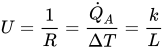
where is the heat flux, is the temperature departure across the material, k is the textile's coefficient of thermal conductivity and L is its thickness. In some contexts, U is referred to as unit surface conductance.[27]


See too: tog (unit) or thermal overall form (where 1 tog = 0.1 m2·Chiliad/W), used for duvet rating.
The term U-cistron is ordinarily used in the U.S. and Canada to express the heat period through entire assemblies (such as roofs, walls, and windows[28]). For example, energy codes such as ASHRAE ninety.1 and the IECC prescribe U-values. However, R-value is widely used in practice to describe the thermal resistance of insulation products, layers, and near other parts of the building enclosure (walls, floors, roofs). Other areas of the world more than commonly use U-value/U-factor for elements of the unabridged building enclosure including windows, doors, walls, roof, and ground slabs.[29]
Units: metric (SI) vs. inch-pound (I-P) [edit]
The SI (metric) unit of measurement of R-value is
- kelvin square-metre per watt (G⋅mtwo/W or, every bit, °C⋅mii/W),
whereas the I-P (inch-pound) unit is
- degree Fahrenheit square-foot hour per British thermal unit (°F⋅ft2⋅h/BTU).[15]
For R-values there is no divergence between U.Southward. and Imperial units, so the same I-P unit is used in both.
Some sources use "RSI" when referring to R-values in SI units.[7] [14]
R-values expressed in I-P units are approximately 5.68 times as large as R-values expressed in SI units.[sixteen] For instance, a window that is R-2 in the I-P arrangement is nigh RSI 0.35, since 2/v.68 ≈ 0.35.
In countries where the SI system is generally in apply, the R-values volition besides unremarkably be given in SI units. This includes the United Kingdom, Commonwealth of australia, and New Zealand.
I-P values are ordinarily given in the United States and Canada, though in Canada normally both I-P and RSI values are listed.[30]
Because the units are usually not explicitly stated, one must decide from context which units are existence used. In this regard, it helps to continue in heed that I-P R-values are five.68 times larger than the respective SI R-values.
More than precisely,[31] [32]
- R-value (in I-P) = RSI-value (in SI) × 5.678263337
- RSI-value (in SI) = R-value (in I-P) × 0.1761101838
Dissimilar insulation types [edit]
The Australian Government explains that the required full R-values for the building fabric vary depending on climate zone. "Such materials include aerated concrete blocks, hollow expanded polystyrene blocks, harbinger bales and rendered extruded polystyrene sheets."[33]
In Federal republic of germany, afterward the police Energieeinsparverordnung (EnEv) introduced in 2009 (October 10) regarding energy savings, all new buildings must demonstrate an power to remain within certain boundaries of the U-value for each particular building material. Further, the EnEv describes the maximum coefficient for each new material if parts are replaced or added to standing structures.[34]
The U.South. Department of Energy has recommended R-values for given areas of the USA based on the general local energy costs for heating and cooling, every bit well as the climate of an surface area. There are four types of insulation: rolls and batts, loose-fill, rigid foam, and cream-in-identify. Rolls and batts are typically flexible insulators that come in fibers, like fiberglass. Loose-fill up insulation comes in loose fibers or pellets and should be diddled into a infinite. Rigid foam is more expensive than cobweb, but generally has a higher R-value per unit of measurement of thickness. Foam-in-place insulation can be blown into modest areas to command air leaks, like those around windows, or can be used to insulate an entire firm.[35]
Thickness [edit]
Increasing the thickness of an insulating layer increases the thermal resistance. For case, doubling the thickness of fiberglass batting will double its R-value, maybe from 2.0 mii⋅K/W for 110 mm of thickness, up to 4.0 grandtwo⋅1000/W for 220 mm of thickness. Rut transfer through an insulating layer is analogous to adding resistance to a series circuit with a fixed voltage. However, this only holds approximately because the effective thermal electrical conductivity of some insulating materials depends on thickness. The add-on of materials to enclose the insulation such as drywall and siding provides boosted but typically much smaller R-value.
Factors [edit]
There are many factors that come into play when using R-values to compute rut loss for a detail wall. Manufacturer R-values apply only to properly installed insulation. Squashing two layers of batting into the thickness intended for one layer volition increase but not double the R-value. (In other words, compressing a fiberglass batt decreases the R-value of the batt but increases the R-value per inch.) Another important gene to consider is that studs and windows provide a parallel oestrus conduction path that is unaffected by the insulation'due south R-value. The practical implication of this is that one could double the R-value of insulation installed between framing members and realize essentially less than a 50 percentage reduction in estrus loss. When installed between wall studs, even perfect wall insulation only eliminates conduction through the insulation merely leaves unaffected the conductive heat loss through such materials every bit drinking glass windows and studs. Insulation installed between the studs may reduce, merely usually does not eliminate, oestrus losses due to air leakage through the building envelope. Installing a continuous layer of rigid cream insulation on the exterior side of the wall capsule will interrupt thermal bridging through the studs while also reducing the charge per unit of air leakage.
Main function [edit]
The R-value is a measure out of an insulation sample's ability to reduce the rate of heat flow nether specified test conditions. The primary mode of rut transfer impeded by insulation is conduction, but insulation also reduces heat loss by all three heat transfer modes: conduction, convection, and radiations. The primary heat loss across an uninsulated air-filled space is natural convection, which occurs considering of changes in air density with temperature. Insulation greatly retards natural convection making conduction the primary mode of heat transfer. Porous insulations accomplish this by trapping air so that pregnant convective estrus loss is eliminated, leaving only conduction and modest radiations transfer. The chief role of such insulation is to make the thermal conductivity of the insulation that of trapped, stagnant air. Notwithstanding this cannot be realized fully because the glass wool or foam needed to prevent convection increases the heat conduction compared to that of however air. The minor radiative heat transfer is obtained by having many surfaces interrupting a "articulate view" between the inner and outer surfaces of the insulation such as visible light is interrupted from passing through porous materials. Such multiple surfaces are abundant in batting and porous foam. Radiation is also minimized by low emissivity (highly reflective) exterior surfaces such as aluminum foil. Lower thermal conductivity, or higher R-values, can be achieved by replacing air with argon when practical such as within special airtight-pore cream insulation considering argon has a lower thermal conductivity than air.
General [edit]
Heat transfer through an insulating layer is analogous to electrical resistance. The oestrus transfers tin exist worked out past thinking of resistance in serial with a fixed potential, except the resistances are thermal resistances and the potential is the difference in temperature from one side of the cloth to the other. The resistance of each material to heat transfer depends on the specific thermal resistance [R-value]/[unit thickness], which is a property of the material (encounter tabular array below) and the thickness of that layer. A thermal barrier that is composed of several layers volition have several thermal resistors in the analogous with circuits, each in series. Coordinating to a set of resistors in parallel, a well insulated wall with a poorly insulated window volition permit proportionally more of the heat to go through the (low-R) window, and additional insulation in the wall will only minimally improve the overall R-value. Every bit such, the to the lowest degree well insulated section of a wall will play the largest office in rut transfer relative to its size, similar to the way most electric current flows through the everyman resistance resistor in a parallel assortment. Hence ensuring that windows, service breaks (effectually wires/pipes), doors, and other breaks in a wall are well sealed and insulated is often the almost cost effective mode to improve the insulation of a structure, once the walls are sufficiently insulated.
Like resistance in electrical circuits, increasing the concrete length (for insulation, thickness) of a resistive element, such equally graphite for instance, increases the resistance linearly; double the thickness of a layer means double the R-value and one-half the rut transfer; quadruple, quarters; etc. In do, this linear relationship does not ever concord for compressible materials such as drinking glass wool and cotton batting whose thermal backdrop change when compressed. Then, for case, if one layer of fiberglass insulation in an attic provides R-20 thermal resistance, calculation on a second layer will not necessarily double the thermal resistance because the outset layer volition be compressed by the weight of the second.
Calculating rut loss [edit]
To detect the average heat loss per unit of measurement area, simply divide the temperature difference by the R-value for the layer.
If the interior of a dwelling house is at twenty °C and the roof cavity is at 10 °C then the temperature deviation is 10 °C (or x K). Assuming a ceiling insulated to RSI 2.0 (R = 2 grandii⋅1000/Due west), free energy will be lost at a rate of x K / (two K⋅thousandtwo/W) = 5 watts for every square meter of ceiling. The RSI-value used here is for the bodily insulating layer (and not per unit thickness of insulation).
Relationships [edit]
Thickness [edit]
R-value should non be confused with the intrinsic property of thermal resistivity and its inverse, thermal electrical conductivity. The SI unit of measurement of thermal resistivity is K⋅m/Westward. Thermal conductivity assumes that the heat transfer of the material is linearly related to its thickness.
Multiple layers [edit]
In calculating the R-value of a multi-layered installation, the R-values of the individual layers are added:[36]
- R-value(outside air pic) + R-value(brick) + R-value(capsule) + R-value(insulation) + R-value(plasterboard) + R-value(within air flick) = R-value(total).
To account for other components in a wall such every bit framing, start calculate the U-value (=1/R-value) of each component, and then the area-weighted boilerplate U-value. The average R-value will be 1/(this average U-value). For example, if ten% of the surface area is iv inches of softwood (R-value five.6) and xc% is 2 inches of silica aerogel (R-value twenty), the area-weighted U-value is 0.1/5.half dozen + 0.9/xx = 0.0629 and the weighted R-value is 1/0.0629 = fifteen.ix.
Controversy [edit]
Thermal electrical conductivity versus apparent thermal conductivity [edit]
Thermal conductivity is conventionally divers every bit the rate of thermal conduction through a material per unit surface area per unit of measurement thickness per unit of measurement temperature differential (ΔT). The inverse of conductivity is resistivity (or R per unit of measurement thickness). Thermal conductance is the rate of heat flux through a unit area at the installed thickness and whatever given ΔT.
Experimentally, thermal conduction is measured by placing the cloth in contact between two conducting plates and measuring the energy flux required to maintain a sure temperature slope.
For the most part, testing the R-value of insulation is done at a steady temperature, ordinarily virtually seventy °F (21 °C) with no surrounding air movement. Since these are ideal conditions, the listed R-value for insulation volition almost certainly exist higher than it would exist in actual employ, because most situations with insulation are under dissimilar conditions
A definition of R-value based on apparent thermal conductivity has been proposed in document C168 published by the American Society for Testing and Materials. This describes heat being transferred by all three mechanisms—conduction, radiation, and convection.
Argue remains among representatives from different segments of the U.S. insulation industry during revision of the U.S. FTC'south regulations about ad R-values[37] illustrating the complexity of the issues.
Surface temperature in human relationship to fashion of oestrus transfer [edit]
There are weaknesses to using a unmarried laboratory model to simultaneously assess the backdrop of a material to resist conducted, radiated, and convective heating. Surface temperature varies depending on the mode of oestrus transfer.
If nosotros assume idealized oestrus transfer between the air on each side and the surface of the insulation, the surface temperature of the insulator would equal the air temperature on each side.
In response to thermal radiations, surface temperature depends on the thermal emissivity of the material. Low-emissivity surfaces such as shiny metal foil volition reduce heat transfer by radiation.
Convection will alter the rate of heat transfer between the air and the surface of the insulator, depending on the flow characteristics of the air (or other fluid) in contact with information technology.
With multiple modes of heat transfer, the final surface temperature (and hence the observed energy flux and calculated R-value) will exist dependent on the relative contributions of radiation, conduction, and convection, even though the total energy contribution remains the same.
This is an important consideration in building construction because heat free energy arrives in different forms and proportions. The contribution of radiative and conductive heat sources also varies throughout the twelvemonth and both are important contributors to thermal condolement
In the hot season, solar radiations predominates as the source of heat gain. According to the Stefan–Boltzmann law, radiative heat transfer is related to the fourth ability of the absolute temperature (measured in kelvins: T [Thou] = T [°C] + 273.16). Therefore, such transfer is at its most meaning when the objective is to cool (i.e. when solar radiation has produced very warm surfaces). On the other paw, the conductive and convective oestrus loss modes play a more pregnant office during the cooler months. At such lower ambient temperatures the traditional fibrous, plastic and cellulose insulations play by far the major role: the radiative heat transfer component is of far less importance, and the main contribution of the radiations barrier is in its superior air-tightness contribution. In summary: claims for radiant bulwark insulation are justifiable at loftier temperatures, typically when minimizing summer rut transfer; but these claims are non justifiable in traditional winter (keeping-warm) conditions.
The limitations of R-values in evaluating radiant barriers [edit]
Dissimilar bulk insulators, radiant barriers resist conducted heat poorly. Materials such equally reflective foil accept a high thermal conductivity and would part poorly every bit a conductive insulator. Radiant barriers retard heat transfer past ii means: by reflecting radiant free energy abroad from its irradiated surface and past reducing the emission of radiations from its reverse side.
The question of how to quantify performance of other systems such as radiant barriers has resulted in controversy and confusion in the building industry with the apply of R-values or 'equivalent R-values' for products which take entirely different systems of inhibiting oestrus transfer. (In the U.Southward., the federal regime'south R-Value Rule establishes a legal definition for the R-value of a building cloth; the term 'equivalent R-value' has no legal definition and is therefore meaningless.) According to current standards, R-values are most reliably stated for bulk insulation materials. All of the products quoted at the end are examples of these.
Calculating the performance of radiant barriers is more complex. With a good radiant barrier in place, virtually oestrus catamenia is by convection, which depends on many factors other than the radiant barrier itself. Although radiant barriers accept loftier reflectivity (and low emissivity) over a range of electromagnetic spectra (including visible and UV light), their thermal advantages are mainly related to their emissivity in the infra-red range. Emissivity values[38] are the appropriate metric for radiant barriers. Their effectiveness when employed to resist heat gain in limited applications is established,[39] even though R-value does non adequately describe them.
Deterioration [edit]
Insulation aging [edit]
While research is lacking on the long-term degradation of R-value in insulation, recent research indicates that the R-values of products may deteriorate over time. For instance, the compaction of loose fill cellulose creates voids that reduce overall performance; this may exist avoided by densely packing at initial installation. Some types of foam insulation, such equally polyurethane and polyisocyanurate are blown into form with heavy gases such as chlorofluorocarbons (Chlorofluorocarbon) or hydrochlorofluorocarbons (HFCs). However, over time these gases diffuse out of the foam and are replaced by air, thus reducing the effective R-value of the product. There are other foams which do non change significantly with aging considering they are blown with water or are open-cell and contain no trapped CFCs or HFCs (e.g., one-half-pound low density foams). On certain brands, 20-year tests have shown no shrinkage or reduction in insulating value.[ citation needed ]
This has led to controversy as how to rate the insulation of these products. Many manufacturers will rate the R-value at the time of manufacture; critics argue that a more fair assessment would be its settled value.[ citation needed ] The foam industry[ when? ] adopted the LTTR (Long-Term Thermal Resistance) method,[40] which rates the R-value based on a 15-year weighted average. However, the LTTR effectively provides only an eight-year anile R-value, short in the calibration of a building that may have a lifespan of 50 to 100 years.
Research has been conducted by the U.South. Regular army Engineer Research and Development Center on the long-term deposition of insulating materials. Values on the degradation were obtained from short-term laboratory testing on materials exposed to various temperature and humidity weather. Results indicate that moisture absorption and loss of blowing amanuensis (in airtight prison cell spray polyurethane foam) were major causes of R-Value loss. Fiberglass and extruded polystyrene retained over 97% of their initial R-values while, aerogels and closed cell polyurethane saw a reduction of 15% and 27.five%, respectively. Results bespeak to the decision that an exponential decay law may exist practical to the reduction in R-values over time for airtight prison cell polyurethanes and aerogel blankets.[41]
Infiltration [edit]
Correct attention to air sealing measures and consideration of vapor transfer mechanisms are important for the optimal function of bulk insulators. Air infiltration can allow convective rut transfer or condensation germination, both of which may degrade the performance of an insulation.
One of the primary values of spray-foam insulation is its power to create an airtight (and in some cases, watertight) seal direct against the substrate to reduce the undesirable effects of air leakage.
R-value in-situ measurements [edit]
The deterioration of R-values is especially a trouble when defining the energy efficiency of an existing edifice. Especially in older or celebrated buildings the R-values defined before structure might exist very different than the bodily values. This profoundly affects energy efficiency analysis. To obtain reliable data, R-values are therefore oftentimes determined via U-value measurements at the specific location (in situ). There are several potential methods to this, each with their specific trade-offs: thermography, multiple temperature measurements, and the heat flux method.[42]
Thermography [edit]
Thermography is applied in the edifice sector to assess the quality of the thermal insulation of a room or building. By ways of a thermographic camera thermal bridges and inhomogeneous insulation parts can be identified. Still, it does not produce any quantitative data. This method can only be used to approximate the U-value or the inverse R-value.

Heat flux measurement set-up

Rut flux measurement results
Multiple temperature measurements [edit]
This approach is based on three or more than temperature measurements within and outside of a building element. By synchronizing these measurements and making some basic assumptions, it is possible to calculate the heat flux indirectly, and thus deriving the U-value of a building chemical element. The following requirements have to be fulfilled for reliable results:
- Difference between within and exterior temperature, platonic > 15 K
- Constant weather
- No solar radiation
- No radiation heat nearby measurements
Heat flux method [edit]
The R-value of a edifice chemical element can be determined past using a heat flux sensor in combination with two temperature sensors.[43] By measuring the estrus that is flowing through a building element and combining this with the inside and outside temperature, it is possible to define the R-value precisely. A measurement that lasts at to the lowest degree 72 hours with a temperature departure of at to the lowest degree 5 °C is required for a reliable consequence according to ISO 9869 norms, simply shorter measurement durations give a reliable indication of the R-value as well. The progress of the measurement can exist viewed on the laptop via respective software and obtained data can be used for further calculations. Measuring devices for such heat flux measurements are offered by companies like FluxTeq,[44] Ahlborn, greenTEG and Hukseflux.
Placing the heat flux sensor on either the inside or exterior surface of the building element allows one to decide the heat flux through the heat flux sensor equally a representative value for the heat flux through the edifice chemical element. The rut flux through the heat flux sensor is the rate of heat flow through the heat flux sensor divided by the surface expanse of the heat flux sensor. Placing the temperature sensors on the inside and outside surfaces of the edifice element allows i to decide the inside surface temperature, outside surface temperature, and the temperature difference between them. In some cases the oestrus flux sensor itself tin can serve as one of the temperature sensors. The R-value for the building element is the temperature difference between the two temperature sensors divided by the heat flux through the estrus flux sensor. The mathematical formula is:
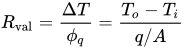
where:
The U-value tin can be calculated likewise by taking the reciprocal of the R-value. That is,
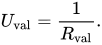
where is the U-value (West⋅thou−ii⋅K−1).

The derived R-value and U-value may be accurate to the extent that the heat flux through the heat flux sensor equals the rut flux through the building element. Recording all of the available data allows one to study the dependence of the R-value and U-value on factors like the within temperature, outside temperature, or position of the heat flux sensor. To the extent that all heat transfer processes (conduction, convection, and radiations) contribute to the measurements, the derived R-value represents an apparent R-value.
Example values [edit]
Vacuum insulated panels have the highest R-value, approximately R-45 (in U.S. units) per inch; aerogel has the next highest R-value (about R-10 to R-30 per inch), followed by polyurethane (PUR) and phenolic cream insulations with R-7 per inch. They are followed closely by polyisocyanurate (PIR) at R-five.8, graphite impregnated expanded polystyrene at R-5, and expanded polystyrene (EPS) at R-four per inch. Loose cellulose, fibreglass (both blown and in batts), and stone wool (both blown and in batts) all possess an R-value of roughly R-2.v to R-4 per inch.
Straw bales perform at about R-ii.38 to 2.68 per inch, depending on orientation of the bales.[45] However, typical straw bale houses accept very thick walls and thus are well insulated. Snow is roughly R-one per inch. Brick has a very poor insulating ability at a mere R-0.2 per inch; however information technology does have a relatively good thermal mass.
Note that the above examples all use the U.S. (non-SI) definition for R-value.
Typical R-values [edit]
This is a list of insulation materials used effectually the globe.
Table notation: RSI-values and R-values for diverse materials and structures are noted. Typical values are approximations based on the average of available figures. The final column gives RSI-values normalised to a 1 metre (3 ft three in) thickness. Clicking on the RSI-value column sorts past median value of the range and clicking on the R-value cavalcade sorts by lowest value.
| Material | Thickness cm (in) | RSI-value (m2·Grand/W) | R-value (ft2·°F·h/BTU) | RSI-value (thouii·Chiliad/W) (per metre) |
|---|---|---|---|---|
| Vacuum insulated console | 2.54 (1) | five.28–8.8 | 14–66[46] | 208–346 |
| Silica aerogel | 2.54 (1) | 1.76 | 10.3[47] | 69 |
| Polyurethane rigid panel (Cfc/HCFC expanded) initial | two.54 (i) | i.23–1.41 | 7–8 | 48–56 |
| Polyurethane rigid panel (Chlorofluorocarbon/HCFC expanded) anile 5–10 years | 2.54 (ane) | 1.10 | six.25 | 43 |
| Polyurethane rigid panel (pentane expanded) initial | 2.54 (1) | one.20 | 6.8 | 47 |
| Polyurethane rigid panel (pentane expanded) aged 5–10 years | 2.54 (1) | 0.97 | 5.5 | 38 |
| Foil faced Polyurethane rigid panel (pentane expanded) | 2.54 (1) | i.1–1.2 | 45–48 [48] | |
| Foil-faced polyisocyanurate rigid console (pentane expanded) initial | two.54 (1) | 1.20 | 6.8 | 55 [48] |
| Foil-faced polyisocyanurate rigid console (pentane expanded) aged five–10 years | ii.54 (ane) | 0.97 | five.5 | 38 |
| Polyisocyanurate spray cream | 2.54 (1) | 0.76–1.46 | four.iii–8.iii | 30–57 |
| Closed-cell polyurethane spray foam | 2.54 (1) | 0.97–1.14 | five.5–six.5 | 38–45 |
| Phenolic spray cream | 2.54 (ane) | 0.85–i.23 | 4.8–vii | 33–48 |
| Thinsulate clothing insulation[49] | ii.54 (i) | 0.28–0.51 | 1.6–2.nine | 11–20 |
| Urea-formaldehyde panels | 2.54 (i) | 0.88–1.06 | v–6 | 35–42 |
| Drywall[l] | 2.54 (one) | 0.15 | .nine | 6.2 |
| Urea foam[51] | ii.54 (ane) | 0.92 | 5.25 | 36.four |
| Extruded expanded polystyrene (XPS) high-density | 2.54 (1) | 0.88–0.95 | 5–5.4 | 26–xl[48] |
| Polystyrene board[51] | 2.54 (one) | 0.88 | 5.00 | 35 |
| Phenolic rigid panel | 2.54 (ane) | 0.seventy–0.88 | 4–5 | 28–35 |
| Urea-formaldehyde foam | ii.54 (ane) | 0.70–0.81 | 4–4.6 | 28–32 |
| High-density fiberglass batts | two.54 (1) | 0.63–0.88 | three.six–v | 25–35 |
| Extruded expanded polystyrene (XPS) depression-density | 2.54 (1) | 0.63–0.82 | 3.6–iv.vii | 25–32 |
| Icynene loose-fill (cascade fill up)[52] | ii.54 (1) | 0.70 | 4 | 28 |
| Molded expanded polystyrene (EPS) high-density | 2.54 (1) | 0.70 | four.ii | 22–32[48] |
| Dwelling Cream[53] | 2.54 (1) | 0.69 | 3.9 | 27.0 |
| Rice hulls[54] | two.54 (1) | 0.l | three.0 | 24 |
| Fiberglass batts[55] | 2.54 (one) | 0.55–0.76 | 3.1–4.3 | 22–30 |
| Cotton batts (Blue Jean insulation)[56] [57] | 2.54 (1) | 0.65 | iii.7 | 26 |
| Molded expanded polystyrene (EPS) low-density | 2.54 (1) | 0.65 | three.85 | 26 |
| Sheep'due south wool Batt [58] | 2.54 (1) | 0.65 | three.seven | 26 |
| Icynene spray[52] [59] | 2.54 (1) | 0.63 | 3.six | 25 |
| Open-cell polyurethane spray foam | two.54 (1) | 0.63 | iii.6 | 25 |
| Cardboard | 2.54 (one) | 0.52–0.7 | 3–4 | 20–28 |
| Stone and slag wool batts | 2.54 (i) | 0.52–0.68 | 3–3.85 | twenty–27 |
| Cellulose loose-make full[60] | two.54 (one) | 0.52–0.67 | 3–3.eight | twenty–26 |
| Cellulose wet-spray[60] | ii.54 (i) | 0.52–0.67 | three–three.viii | 20–26 |
| Rock and slag wool loose-fill[61] | 2.54 (1) | 0.44–0.65 | 2.v–iii.7 | 17–26 |
| Fiberglass loose-make full[61] | 2.54 (one) | 0.44–0.65 | two.5–3.seven | 17–26 |
| Polyethylene foam | 2.54 (1) | 0.52 | 3 | xx |
| Cementitious foam | 2.54 (i) | 0.35–0.69 | 2–3.9 | fourteen–27 |
| Perlite loose-fill up | 2.54 (1) | 0.48 | 2.7 | nineteen |
| Woods panels, such every bit sheathing | 2.54 (one) | 0.44 | two.5 | 17 (9[62]) |
| Fiberglass rigid panel | two.54 (ane) | 0.44 | 2.5 | 17 |
| Vermiculite loose-fill | 2.54 (1) | 0.38–0.42 | 2.13–2.4 | fifteen–17 |
| Vermiculite[63] | 2.54 (1) | 0.38 | 2.13 | 16–17[48] |
| Straw bale[45] | 2.54 (1) | 0.26 | 1.45 | 16–22[48] |
| Papercrete[64] | 2.54 (1) | 2.6–iii.two | 18–22 | |
| Softwood (most)[65] | two.54 (1) | 0.25 | ane.41 | 7.7 [62] |
| Wood chips and other loose-make full wood products | ii.54 (1) | 0.eighteen | one | seven.1 |
| Aerated/Cellular Concrete (five% moisture) | two.54 (1) | 0.xviii | 1 | 7.i |
| Snow | 2.54 (ane) | 0.18 | one | 7.i |
| Hardwood (most)[65] | ii.54 (1) | 0.12 | 0.71 | 5.5 [62] |
| Brick | 2.54 (one) | 0.030 | 0.2 | 1.3–1.8[62] |
| Drinking glass[51] | 2.54 (one) | 0.025 | 0.fourteen | 0.98 |
| Uninsulated drinking glass pane | 0.vi (0.25) | 0.16 | 0.91 | 0.98 |
| Insulated glass (double glazed) | 1.6–1.9 (0.63–0.75) | 0.35 | 2 | xl |
| Insulated drinking glass (double glazed, hard low-e) | 1.6–1.9 (0.63–0.75) | 0.67 | 3.eight | 77 |
| Insulated glass (double glazed, soft low-e) | one.6–1.9 (0.63–0.75) | 0.90 | 5.11 | 100 |
| Insulated glass (triple glazed) | 3.two–iii.8 (one.2–1.5) | 0.67 | 3.8 | 40 |
| Poured physical[51] | 2.54 (1) | 0.014 | 0.08 | 0.43–0.87 [62] |
| Material | Thickness cm (in) | RSI-value (m2·One thousand/Due west) | R-value (ft2·°F·h/BTU) | RSI-value (mtwo·K/W) (per metre) |
Typical R-values for surfaces [edit]
Not-cogitating surface R-values for air films [edit]
When determining the overall thermal resistance of a building associates such as a wall or roof, the insulating effect of the surface air film is added to the thermal resistance of the other materials.
| Surface position | Direction of rut transfer | RU.Due south. (hr⋅ft2⋅°F/Btu) | RSI (Grand⋅chiliad2/Due west) |
|---|---|---|---|
| Horizontal (due east.g., a flat ceiling) | Up (e.g., wintertime) | 0.61 | 0.xi |
| Horizontal (due east.thou., a flat ceiling) | Downward (eastward.chiliad., summertime) | 0.92 | 0.16 |
| Vertical (eastward.thou., a wall) | Horizontal | 0.68 | 0.12 |
| Outdoor surface, any position, moving air 6.vii k/south (wintertime) | Any direction | 0.17 | 0.030 |
| Outdoor surface, any position, moving air three.four m/s (summertime) | Whatever direction | 0.25 | 0.044 |
[66]
In do the to a higher place surface values are used for floors, ceilings, and walls in a edifice, but are not accurate for enclosed air cavities, such as between panes of glass. The effective thermal resistance of an enclosed air cavity is strongly influenced past radiative heat transfer and altitude between the two surfaces. See insulated glazing for a comparison of R-values for windows, with some effective R-values that include an air cavity.
Radiant barriers [edit]
| Material | Credible R-Value (Min) | Credible R-Value (Max) | Reference |
|---|---|---|---|
| Reflective insulation | Zero[67] (For associates without adjacent air space.) | R-10.7 (oestrus transfer downwardly), R-vi.seven (rut transfer horizontal), R-five (heat transfer upwards) Enquire for the R-value tests from the manufacturer for your specific assembly. | [61] [68] |
R-Value Rule in the U.S. [edit]
The Federal Trade Commission (FTC) governs claims most R-values to protect consumers confronting deceptive and misleading ad claims. It issued the R-Value Rule.[69]
The primary purpose of the rule is to ensure that the domicile insulation marketplace provides this essential pre-purchase data to the consumer. The data gives consumers an opportunity to compare relative insulating efficiencies, to select the production with the greatest efficiency and potential for energy savings, to brand a cost-effective buy and to consider the primary variables limiting insulation effectiveness and realization of claimed energy savings.
The rule mandates that specific R-value data for abode insulation products be disclosed in certain ads and at the signal of sale. The purpose of the R-value disclosure requirement for advertising is to forestall consumers from being misled by sure claims which have a bearing on insulating value. At the point of transaction, some consumers will exist able to get the requisite R-value information from the label on the insulation packet. Withal, since the prove shows that packages are frequently unavailable for inspection prior to buy, no labeled data would exist available to consumers in many instances. As a issue, the Rule requires that a fact sheet be available to consumers for inspection before they make their purchase.
Thickness [edit]
The R-value Rule specifies:[70]
- a. Yous can do this if you suggest using your product at a ane-inch thickness.
- b. You lot can do this if actual test results show that the R-values per inch of your production does non drop equally it gets thicker.
You tin list a range of R-value per inch. If you do, you lot must say exactly how much the R-value drops with greater thickness. You must too add together this argument: "The R-value per inch of this insulation varies with thickness. The thicker the insulation, the lower the R-value per inch."
Run across also [edit]
- Building insulation
- Building insulation materials
- Condensation
- Cool roofs
- Heat transfer
- Passivhaus
- Passive solar design
- Sol-air temperature
- Superinsulation
- Thermal bridge
- Thermal comfort
- Thermal conductivity
- Thermal mass
- Thermal transmittance
- Tog (unit)
References [edit]
- ^ Kahn, Jeffery (1991), Aerogel Inquiry at LBL: From the Lab to the Market place, Lawrence Berkeley National Laboratory, retrieved iv March 2021
- ^ Lechner, Norbert (2015). Heating, Cooling, Lighting: Sustainable Blueprint Methods for Architects (4th ed.). Hoboken, NJ: Wiley. p. 676. ISBN978-1-118-58242-8.
- ^ Us Department of Energy, Faced fibreglass batt insulation tin can exist stapled to the stud faces or slightly inset, just avoid compressing the batts, United States Section of Energy, retrieved 5 February 2018
- ^ a b c d Ellis, Wayne (1988). "Appendix: Terminology update: Symbols mean specific terms". In Strehlow, Richard Alan (ed.). Standardization of Technical Terminology: Principles and Practices. Vol. 2d. Philadelphia, PA: ASTM. p. 97. ISBN0-8031-1183-five.
- ^ Rabl, Ari; Curtiss, Peter (2005). "ix.half dozen Principles of Load Calculations". In Kreith, Frank; Goswami, D. Yogi (eds.). CRC Handbook of Mechanical Applied science (Second ed.). Boca Raton, FL: CRC Press. ISBN0-8493-0866-6.
- ^ a b Rathore, M. One thousand.; Kapuno, R. (2011). Applied science Heat Transfer (2nd ed.). Sudbury, MA: Jones & Bartlett Learning. p. 22. ISBN978-0-7637-7752-4.
- ^ a b c d due east Fenna, Donald (2002). A Dictionary of Weights, Measures, and Units. Oxford, U.k.: Oxford University Printing. ISBN019-860522-6.
- ^ a b "U-Value Measurement Case Written report". Retrieved 2014-x-29 .
- ^ a b c Kośny, Jan; Yarbrough, David Due west. (2017). "4.x Thermal Bridges in Building Structures". In Chhabra, Ray P. (ed.). CRC Handbook of Thermal Technology (Second ed.). Boca Raton, FL: CRC Press. ISBN978-1498715270.
- ^ Kreider, January F.; Curtiss, Peter S.; Rabl, Ari (2010). Heating and Cooling of Buildings: Pattern for Efficiency (Revised Second ed.). Boca Raton, FL: CRC Printing. p. 28. ISBN978-ane-4398-8250-four.
- ^ Chen, C. Julian (2011). Physics of Solar Energy (Illustrated ed.). Hoboken, NJ: Wiley. p. 276. ISBN978-0-470-64780-6.
- ^ a b c Krause, Carolyn (Summertime 1980). "The Promise of Energy-Efficient Buildings". Oak Ridge National Laboratory Review. xiii (3): half dozen.
- ^ American Social club of Heating, Refrigerating and Air-conditioning Engineers (2013). "Heat, air, and moisture command in edifice assemblies—Fundamentals". 2013 ASHRAE Handbook. Vol. Fundamentals (SI ed.). Atlanta, GA: ASHRAE. pp. 25.five–25.half dozen. ISBN978-one-936504-46-six.
- ^ a b Harvey, L. D. Danny (2006). A Handbook on Low-Energy Buildings and District-Free energy Systems: Fundamentals, Techniques and Examples. London, U.k.: Earthscan, an imprint of Routledge, an imprint of Taylor & Francis. p. 39. ISBN978-184407-243-9.
- ^ a b Lechner, Norbert (2015). Heating, Cooling, Lighting: Sustainable Pattern Methods for Architects (4th ed.). Hoboken, NJ: Wiley. pp. 683–685. ISBN978-1-118-58242-viii.
- ^ a b Harvey, 50. D. Danny (2006). A Handbook on Low-Energy Buildings and District-Energy Systems: Fundamentals, Techniques and Examples. London, U.k.: Earthscan, an banner of Routledge, an imprint of Taylor & Francis. p. twoscore. ISBN978-184407-243-ix.
- ^ a b Lechner, Norbert (2015). Heating, Cooling, Lighting: Sustainable Pattern Methods for Architects (quaternary ed.). Hoboken, NJ: Wiley. p. 508. ISBN978-1-118-58242-8.
- ^ Harvey, L. D. Danny (2006). A Handbook on Depression-Energy Buildings and Commune-Energy Systems: Fundamentals, Techniques and Examples. London, Uk: Earthscan, an imprint of Routledge, an imprint of Taylor & Francis. p. 40. ISBN978-184407-243-9.
- ^ International Code Council (2010). Residential Code of New York State (2010 ed.). Washington, D.C.: International Code Quango. ISBN978-1609830014.
- ^ Harvey, L. D. Danny (2006). A Handbook on Low-Free energy Buildings and District-Energy Systems: Fundamentals, Techniques and Examples. London, UK: Earthscan, an banner of Routledge, an imprint of Taylor & Francis. p. 51. ISBN978-184407-243-9.
- ^ The Polyisocyanurate Insulation Manufacturers Association (PIMA), LTTR/QualityMark, The Polyisocyanurate Insulation Manufacturers Association (PIMA), retrieved 5 February 2018
- ^ Bailes, Allison (24 Apr 2013), Big News: The R-Value of Insulation Is Not a Constant, Energy Vanguard, retrieved 5 February 2018
- ^ Building Scientific discipline Corporation (23 January 2013), RR-0002: The Thermal Metric Project, Building Science Corporation, retrieved 5 February 2018
- ^ "Foams". world wide web.isover.com.
- ^ "European phenolic foam clan: Properties of phenolic foam". Archived from the original on 2016-05-23.
- ^ "Indicators of Insulation Quality: U-value and R-value" (PDF). U-value and building physics. greenTEG. 2016-03-17. Retrieved 2016-03-17 .
- ^ McQuiston, Faye C.; Parker, Jerald D.; Spitler, Jeffrey D. (2005). Heating, Ventilating, and Air conditioning: Analysis and Design (Sixth ed.). Hoboken, NJ: Wiley. ISBN978-0-471-47015-1.
- ^ "Efficient Windows Collaborative".
- ^ "Public Codes Cyberregs". Archived from the original on 2016-03-04.
- ^ Canada Mortgage and Housing Corporation (CMHC) (2018), Insulating Your Business firm, Canada Mortgage and Housing Corporation (CMHC), retrieved 5 February 2018
- ^ American Society of Heating, Refrigerating and Air-conditioning Engineers (2013). "Units and Conversions". 2013 ASHRAE Handbook. Vol. Fundamentals (SI ed.). Atlanta, GA: ASHRAE. p. 38.1. ISBN978-1-936504-46-six.
- ^ Cardarelli, François (1999). Scientific Unit of measurement Conversion: A Practical Guide to Metrication (Second ed.). London, UK: Springer Science+Business Media. p. 308. ISBN978-1-4471-0805-4.
- ^ "Insulation | YourHome". www.yourhome.gov.au.
- ^ "Bundesgesetzblatt" (PDF). www.bgbl.de.
- ^ "Insulation". U.S. Department of Energy. USA.gov. October 2010. 14 November 2010.
- ^ "Archived copy". Archived from the original on 2007-01-12. Retrieved 2007-01-10 .
{{cite web}}: CS1 maint: archived re-create as championship (link) - ^ "Consumer Information". Consumer Information.
- ^ "FAQ - EOI". www.electro-optical.com.
- ^ "FSEC-CR-1231-01-ES". www.fsec.ucf.edu.
- ^ "Thermal resistance and polyiso insulation" Archived 2012-06-09 at the Wayback Automobile by John Clinton, Professional Roofing magazine, February 2002
- ^ Stephenson, 50. D.; Heffron, Andrew; Mehnert, Brenda B. (2015-05-01). "Prediction of Long Term Degradation of Insulating Materials". Defence force Technical Information Center. Retrieved 29 September 2021. PDF
- ^ "Case study: U-value measurement" (PDF). [ permanent dead link ]
- ^ "U-value and building physics". greenTEG. Retrieved 2016-03-17 .
- ^ "Thermal Monitoring of Buildings". FluxTeq. Retrieved 2016-06-15 .
- ^ a b "R-Value of Straw Bales Lower Than Previously Reported – EBN: 7:ix". Buildinggreen.com. September 1, 1998. Retrieved 2018-10-03 .
- ^ https://b2b-api.panasonic.eu/file_stream/pids/fileversion/3247[ bare URL PDF ]
- ^ http://www.starch.dk/private/energy/img/Spaceloft_DS.pdf[ bare URL PDF ]
- ^ a b c d e f Free energy Saving Trust. "CE71 – Insulation materials chart – thermal backdrop and ecology ratings". Energysavingtrust.org.uk. Retrieved 2014-02-23 .
- ^ "Archived copy" (PDF). Archived from the original (PDF) on 2014-x-21. Retrieved 2014-ten-fourteen .
{{cite web}}: CS1 maint: archived copy as title (link) - ^ http://coloradoenergy.org/procorner/stuff/r-values.htm
- ^ a b c d Ristinen, Robert A., and Jack J. Kraushaar. Free energy and the Environment. 2nd ed. Hoboken, NJ: John Wiley & Sons, Inc., 2006.
- ^ a b "The Icynene Insulation Arrangement". June 12, 2008. Archived from the original on June 12, 2008. Retrieved August nine, 2009.
- ^ "Elastochem Specialty Chemicals | Foams: Spray Foam Insulation, Injection Cream and Pour in Place Foam". Elastochem-ca.com. Archived from the original on 2014-03-03. Retrieved 2014-02-23 .
- ^ "Rice hulls in construction – Appropedia: The sustainability wiki". Appropedia. 2013-02-23. Retrieved 2014-02-23 .
- ^ "Products | Johns Manville Insulation". Jminsulation.com.au. Archived from the original on 2014-02-26. Retrieved 2014-02-23 .
- ^ "Dark-green Building Materials, Dark-green Products". Greendepot.com . Retrieved 24 February 2019.
- ^ "What is Greenish Living?". Archived from the original on September 29, 2008. Retrieved May 8, 2009.
- ^ "sheep'south wool specifications" (PDF).
{{cite spider web}}: CS1 maint: url-condition (link) - ^ "Archived copy". Archived from the original on 2014-07-23. Retrieved 2014-07-17 .
{{cite web}}: CS1 maint: archived copy as title (link) - ^ a b "ICC Legacy Report ER-2833 – Cocoon Thermal and Audio Insulation Products". ICC Evaluation Services, Inc. Retrieved 2014-02-23 .
- ^ a b c "Buildings Free energy Data Book". Buildingsdatabook.eren.doe.gov. Archived from the original on 2014-02-27. Retrieved 2014-02-23 .
- ^ a b c d e Brian Anderson (2006). "Conventions for U-value calculations" (PDF). Bre.co.uk. Retrieved 2014-02-23 .
- ^ "Evergreen Insulation - Types of insulation and R-Values". 27 July 2013. Retrieved 27 August 2021.
- ^ "Archived copy" (PDF). Archived from the original (PDF) on 2014-07-07. Retrieved 2014-07-21 .
{{cite web}}: CS1 maint: archived re-create as title (link) - ^ a b "Home Blueprint & Remodeling | Section of Energy". Energysavers.gov. Retrieved 2014-02-23 .
- ^ 2009 ASHRAE Handbook - Fundamentals (I-P Edition & SI Edition). (pp: 26.1). American Society of Heating, Refrigerating and Air-Workout Engineers, Inc
- ^ FTC Alphabetic character, Regarding cogitating insulation used nether slab where no air space is nowadays
- ^ ICC ES Written report, ICC ES Report ESR-1236 Thermal and Moisture Protection - ICC Evaluation Services, Inc.
- ^ "R-Value Rule". 26 July 2013.
- ^ "Electronic Lawmaking of Federal Regulations (eCFR)". Electronic Code of Federal Regulations (eCFR).
External links [edit]
- Table of Insulation R-Values at InspectApedia includes original source citations
- Data on the calculations, meanings, and inter-relationships of related heat transfer and resistance terms
- American building material R-value table
- Working with R-values
- Insulation R-value Explained
Source: https://en.wikipedia.org/wiki/R-value_(insulation)
Posted by: webbmuther.blogspot.com
0 Response to "How To Increase R Value Of Windows"
Post a Comment